
Heat Geek Super Cylinder
Designed to minimise distortion and maximise stratification. Independently monitored and consistently achieving hot water at 400 to 550% efficiency with a heat pump.
Designed from the ground up for heat pump efficiency
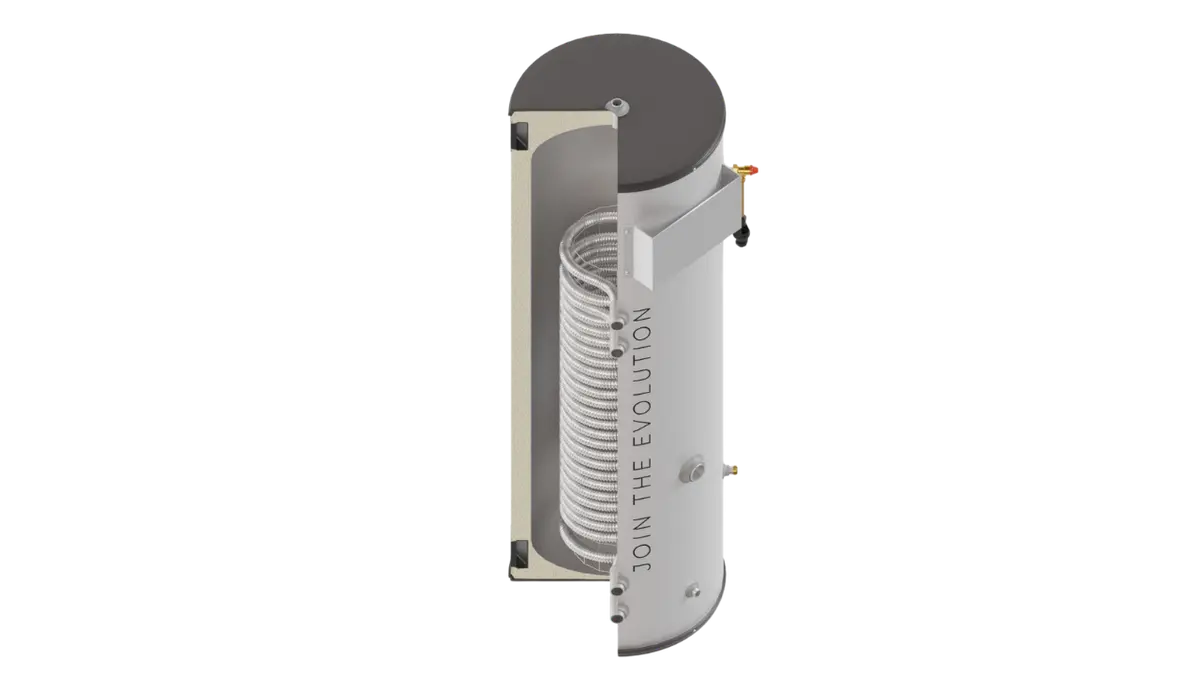
The Super Cylinder is designed by Heat Geek and manufactured by Newark Cylinders. It is built around two principles that determine how efficiently a heat pump heats hot water: distortion and stratification. Every design decision, from the coil configuration to the cold inlet diffuser, is aimed at keeping flow temperatures as low as possible.
The cylinder is independently monitored at Heat Pump Monitor. Homes with a Super Cylinder and a well-commissioned heat pump consistently achieve hot water COP between 400 and 550%.
Why hot water efficiency depends on cylinder design
When a heat pump heats your hot water, the water in the heating circuit and the domestic hot water in your cylinder are kept separate. Heat transfers across a coil inside the cylinder. To push heat from one side to the other, the heat pump needs to run at a higher temperature than the water in the store. The gap between those two temperatures is called distortion.
The larger the distortion, the hotter the heat pump has to run. The hotter it runs, the lower its efficiency. Reducing distortion is the single most effective way to improve hot water efficiency.
What distortion means in practice
A heat pump delivering hot water at 60°C flow temperature might achieve 250 to 300% COP. The same heat pump at 48°C flow temperature can achieve 400% or more. The cylinder design determines how low that flow temperature can go.
Two things reduce distortion. A larger heat exchanger coil gives more surface area for heat to transfer, so less temperature difference is needed to move the same amount of energy. And cooler water around the coil creates a better temperature gradient: the cooler the water the coil sits in, the less distortion is needed to drive heat transfer.
Stratification: keeping the coil in cool water
In any hot water cylinder, warm water rises and cool water sinks. If this separation, called stratification, is preserved well, the coil at the bottom of the cylinder sits in the coolest water available. This pulls the required flow temperature down further.
Stratification is disrupted by turbulence. Cold water entering the cylinder too fast mixes the hot and cold zones, raising the temperature around the coil and increasing the flow temperature the heat pump needs. The Super Cylinder uses a 35mm diffuser tube on the cold water inlet to slow the incoming water and preserve stratification throughout a heating cycle.
What the Super Cylinder does differently
Coil surface area. The Super Cylinder has 6.0 m² of heat exchanger surface area across two 3.0 m² coils. Most standard cylinders have significantly less. More surface area means the heat pump can reach the heat source saturation point at lower flow temperatures, where the cylinder absorbs energy as fast as the heat pump can produce it.
Cold inlet diffuser. The 35mm diffuser tube slows incoming cold water so it settles at the bottom without disrupting the thermocline between hot and cold zones.
Tall, slim construction. A taller, narrower cylinder keeps the hot and cold zones separated over a longer vertical distance, making stratification more stable and longer-lasting.
Independent monitoring. The Super Cylinder is tracked via Heat Pump Monitor. Average hot water COP across monitored installations is consistently between 400 and 550%.
Choosing the right size
Larger cylinders work better with heat pumps for two reasons. A bigger store means you can keep the water temperature lower and still have enough hot water available. Heat pumps prefer low flow temperatures, so this matters for efficiency. A larger cylinder also gives you more capacity to pre-heat during cheap overnight tariff periods or when solar PV is generating.
The Super Cylinder is available from 150 L to 500 L. There is also a B-range from 200 L to 300 L for installations with restricted ceiling height. Use the sizing guide below as a starting point. If you have solar PV or a variable-rate tariff, erring toward the larger size gives you more flexibility.
Controls matter too
Getting the cylinder right is one half of achieving high hot water efficiency. The other half is how the system is controlled. Store temperature, anti-legionella scheduling, and tariff integration all affect the result. A well-commissioned system with a Super Cylinder and correctly set controls is what produces consistent 400 to 550% COP. Our hot water efficiency settings guide covers the controls side in full.
Specifications
| Heat exchanger surface area | 6.0 m² (two 3.0 m² coils) |
| Cold inlet | 35 mm diffuser tube |
| Construction | Tall, slim unvented |
| Available sizes | 150 L to 500 L |
| B-range (restricted height) | 200 L to 300 L |
| Typical hot water COP | 400 to 550% |
| Monitoring | Heat Pump Monitor |
| Manufacturer | Newark Cylinders |
Sizing guide
| Bedrooms | Bathrooms | Recommended size |
|---|---|---|
| 1 to 2 | 1 | 180 L |
| 3 | 1 | 180 L |
| 3 | 2 | 210 L |
| 4 | 2 | 250 L |
| 5 | 2 | 300 L |
| 6 | 3 | 300 to 400 L |
Get a free, personalised estimate in seconds