
Table of Contents
- What hot water temperature should I set?
- When should I time my hot water to heat up?
- What is the right setback temperature for a heat pump?
- Should I set a lower comfort temperature?
- How do I set the holiday or absence mode?
- What is a heating curve and do I need to adjust it?
- Summary: the settings that matter most
- Want help getting your heat pump set up properly from day one?
- Is your home ready for the switch?
Quick Verdict: Heat pump controller settings are important for maximising efficiency and reducing running costs. Most homeowners leave significant efficiency on the table through controller settings alone. Keep your hot water storage as low as safely possible, time it to heat once a day, set your setback temperature no more than three degrees below your comfort temperature, and run your system in steady state. Those four things account for around 98% of the efficiency gains available.
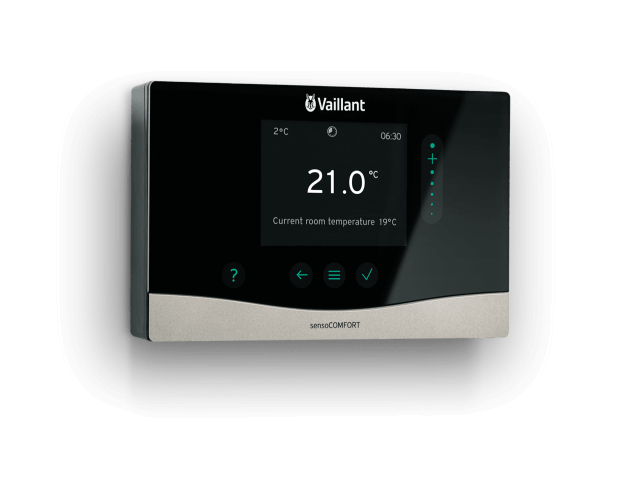
In this video, we walk through the key controller settings using the Vaillant sensoCOMFORT on an Arotherm Plus heat pump. Every setting covered applies equally to a modern condensing gas boiler.
What hot water temperature should I set?
Keeping your hot water too hot is one of the two most common efficiency problems we see. If your cylinder sits at 65°C but you have to mix it back down with cold water before it is usable, you have been paying to heat water you are then deliberately cooling.
For most homes, around 50°C is the right target for larger cylinders. Smaller cylinders sometimes need to go a little higher to avoid running short. If your system has an analogue thermostat on the cylinder, treat its reading with caution. These drift over time and the dial often does not reflect the actual stored temperature. The Vaillant sensoCOMFORT uses digital sensors, so the readings are reliable.
To find the setting: Menu > Control > DHW (domestic hot water) > DHW Temperature.
For a full breakdown of the trade-offs between storage temperature, comfort and safety: What temp should hot water really be?
What about Legionella? Is a low storage temperature safe?
Yes, with the right safeguard. The DHW menu also includes a Legionella programme, which schedules a weekly heat-up to a higher temperature for sterilisation. You get the efficiency of low-temperature storage without skipping the safety step.
When should I time my hot water to heat up?
Heat the cylinder once a day, just enough so you do not run short. Timing it well makes a difference.
For heat pumps, around 1pm works well. The outside air is at its warmest then, so the heat pump is running at its highest efficiency. If you have access to a cheap night tariff such as Octopus Go, time your hot water to that window instead. The tariff savings will outweigh the efficiency gains of afternoon heating by some margin.
On the sensoCOMFORT, go to the Weekly Planner, enter your on and off times using the scroll bar, and copy any day's programme into another day directly from the screen.
What if I want to experiment with lower temperatures without the risk of running out?
Add a second heating window as a backup. You can then test a lower storage temperature knowing that if the first heat-up falls short, the system will cover the gap. There is also a hot water boost button for moments when the tank is off-schedule but you need hot water quickly.
What is the right setback temperature for a heat pump?
The second most common efficiency problem is erratic heating. Large swings in temperature throughout the day work against both efficiency and comfort. Think of it like driving: a modern heat pump or condensing boiler works best when driven gently and consistently. Every time the system shuts off completely, it has to work hard to bring everything back up to temperature. The pipe work, walls, and thermal mass of the building all need reheating before the air temperature even begins to rise.
The setback temperature is what your home targets during the "off" period on your schedule. The higher you set it, the less the system has to catch up when it kicks back in.
Our recommendation: set your setback temperature no more than three degrees below your comfort temperature. So if you target 20°C when home, set the setback to at least 17°C. The system keeps ticking over gently rather than cold-starting from scratch.
Should I set a lower comfort temperature?
A lower comfort temperature sounds like being colder, but steady state heating changes the equation.
When a system runs in steady state, it holds a gentle, consistent background temperature rather than cycling between hot and cold. The practical result is that your comfort band widens. Someone previously comfortable only between 20°C and 21°C often finds that in steady state their comfortable range shifts to something like 19°C to 22°C. Higher radiant heat from surfaces, lower convection, more even air temperatures throughout the rooms — these combine to make a lower nominal setting feel warmer than it would have before.
People tend to gradually close the gap between their setback and comfort temperatures as they get used to it. Some end up running at a single constant temperature around the clock, which gives you the highest efficiency possible. Others simply find they feel warmer at a lower thermostat setting than before, and spend less in the process.
For more on this: Is it better to leave your heating on all day?
What other benefits does steady state heating have?
Aside from efficiency, steady state improves air quality. Lower convection means less dust circulating through the home. There is also less internal condensation, which reduces the conditions that lead to mould. Fewer cold starts reduce wear on system components and slow corrosion over time.
Most people who try steady state do not want to go back.
How do I set the holiday or absence mode?
On the sensoCOMFORT, the holiday setting is under Absence. Enter your departure and return dates and the system drops to setback temperature mode for that period.
Do not go below 12°C. Most home insurance policies require some level of heating when the property is unoccupied, and 12°C is generally the floor for preventing mould and damp. Personally, going that low is only worth it for a prolonged absence. A practical rule of thumb: drop one degree for every day you will be away, stopping at around 15°C.
One thing people often forget: turn the heating back on the day before you return. Coming home to a cold house is miserable and entirely avoidable.
The Vaillant app lets you set absence mode remotely, which is useful if you forget before leaving.
What is a heating curve and do I need to adjust it?
Your heating engineer should set this up at commissioning, but it is worth knowing what it does.
Advanced systems like the Vaillant Arotherm Plus use weather compensation. The system reads the outside air temperature and adjusts the flow temperature of the water in your heating circuit accordingly. In cold weather, the flow temperature rises slightly; on a mild day, it drops. This keeps the system running at the lowest possible flow temperature that will still heat your home, which is where both heat pumps and condensing boilers are most efficient.
The heating curve is the slope that controls this relationship. Two situations where you might need to revisit it: if your home consistently overheats, reduce the curve by one increment and give it a few days to settle. If you add loft insulation or carry out other upgrades, the curve can come down too. Your home now needs less heat, so the system runs at a lower flow temperature, and lower flow temperatures mean higher efficiency.
To find it: Settings > Installer Level > System Configuration > select your zone > Heating Curve.
The lower the curve can be set while your home still stays comfortable, the more efficiently the system runs.
Summary: the settings that matter most
SettingWhat to doHot water temperatureAround 50°C for most cylinders; as low as safely possibleHot water timingHeat once daily; 1pm for heat pumps, or off-peak tariff windowLegionella programmeEnable the weekly sterilisation cycleSetback temperatureNo more than 3°C below your comfort temperatureComfort temperatureConsider lowering slightly once running in steady stateAbsence modeDrop 1°C per day away, floor at around 15°CHeating curveLet your engineer set this; revisit if you add insulation
If you have a Daikin heat pump, we have a dedicated video walking through its heat pump controller settings settings: Daikin Heat Pump Controller Settings
For older Vaillant controller models, there is a version covering those too here.
Want help getting your heat pump set up properly from day one?
Getting the heat pump controller settings right only gets you so far if the system was not sized or commissioned properly in the first place. At Heat Geek, every installation is designed and configured for efficiency from the start.
Is your home ready for the switch?
You don't need a brand-new home or massive radiators to benefit from a heat pump. Through intelligent design and proper system balancing, even older semi-detached homes can achieve excellent efficiency.
See what a heat pump looks like for your home using the button below. Get an Instant Estimate
Why Heat Geek?
Heat Geek is the UK’s leading platform for high-performance heat pump installs. We don't just "fit a box"; we design systems that meet—and often exceed—the technical rigour of the Future Homes Standard.
Through our ZeroDisrupt™ approach, we use AI to design a system specifically for your property’s heat loss. This ensures your heat pump runs at its maximum potential efficiency, giving you the same "low-bill" lifestyle promised to new-build buyers.
Don’t Just Take Our Word for It
✅ Read our latest verified reviews
✅ View our Which? Trusted Traders profile
When you're comparing heat pump installers, don’t just look at price, look at what real customers say, and how those reviews are collected. Verified reviews help you cut through the noise.